
Modi invoked the epics of Ramayana and Mahabharata to assert that it is in Indian tradition to avoid war be it in Lanka or Kurukshetra and the country stands for world peace.

"Those who wish America harm, we will hunt you down and you will pay the ultimate price," the US President said

In a statement, senior Congress leader Jairam Ramesh also described the government's strategy in dealing with the Chinese in Ladakh as 'DDLJ- Deny, Distract, Lie and Justify' and Jaishankar's remarks an implied cheap shot at former party chief Rahul Gandhi.

'Why wouldn't so strategically-minded an adversary, such as China, not militarily exploit to the maximum Indian timidity, stupidity, and cupidity all along the LAC and legitimate, as it has done so often in the past, the fait accompli of incremental territorial grabs which, by the way, is its strategy and policy as implemented on the ground?'
Future conflict will involve bypassing of frontiers to strike at critical vulnerabilities directly and in the hinterland at the appropriate time, explains Lieutenant General Anil Chait (retd), who served as chief of the Integrated Defence Staff and Central Army Commander.
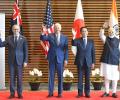
India has the ability in all respects to be a great power and address our security challenges in the best national interests, says Commodore Venugopal Menon (retd).

Colonel Anil Athale (retd) lists a few military tactics that may help team India win the World Cup.

China is going to be an indispensable partner in Russia's ongoing crisis with the US, while on its part, China cannot remain indifferent if Russia gets crushed by the US, lest it loses 'strategic depth', observes Ambassador M K Bhadrakumar.

The Wayanad MP also said that he supports Indian foreign policy and doesn't have a huge disagreement with it with regard to India's position on the Russia-Ukraine war.

President Obama had no intention of risking a global conflagration on account of the use of chemical weapons in Syria, especially at a time when he was struggling to wind up the wars his predecessor had started, says T P Sreenivasan

Haasan, addressing office bearers in Chennai, said he has been invited by Rahul Gandhi to participate in the Yatra.
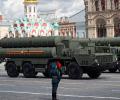
Two powerful US Senators have urged President Joe Biden not to impose provisions of the punitive Countering America's Adversaries Through Sanctions Act against India for buying the S-400 surface-to-air missile system from Russia.

Beijing will be intently watching Washington's response for any hint of weakness. Xi Jinping, who feels China has a limited window of strategic opportunity, will be emboldened to take additional initiatives in the Indo-Pacific and specifically against India and Taiwan, warns Jayadeva Ranade, the former senior RA&W officer and China expert.

'Once positions are hardened and troops start building defences, it is difficult for soldiers to step back.'

The IAF has planned several activities at the air base to commemorate the 20 years of the war and the symbolic recreation of the Tiger Hill attack was one of them.

The blast occurred in the mosque in the Police Lines area around 1.40 pm when a suicide bomber present in the front row during the Zuhr (afternoon) prayers blew himself up, security officials said.

The transgression took place on August 30, and the Chinese troops returned from the area after spending few hours, they said.
Using available government data, the team is targeting $30-40 billion worth of iron and steel products that are imported into India.

Prime Minister Narendra Modi along with his counterparts from Australia and Japan on Friday attended the first in-person meeting of Quad leaders hosted by US President Joe Biden during which they plan to discuss issues like climate change, Covid-19 pandemic and challenges in the Indo Pacific, amidst China's growing military presence in the strategic region.
Terming India's proposal of "massive up-gradation" of defence infrastructure along the Sino-Indian border as "bold moves", Beijing has said it implied that New Delhi was "starting to treat China as a de facto competitor".
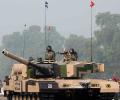
Senior Colonel Liu Degang said the Arjun tank is "very good" and suits Indian conditions.

'The numbers of troops on both sides are enormous.' 'They are about 50,000-60,000 soldiers facing each other in that sector -- that's about the total number of troops that both sides had in the 1962 War in all sectors.'

Xi ordered country's 2.3 million-strong military to be absolutely loyal to the party, to focus on how to win in wars, to pioneer reforms and innovation, to scientifically manage commanding a unit, to lead troops in accordance with the strictest standards and to take the forefront in complying with laws and regulations.
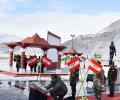
The Chinese authorities have been rapidly building defence infrastructure along the Line of Actual Control, indicating that they are preparing for a long period of tension with India, points out Jayadeva Ranade, the former senior RA&W officer and China expert.
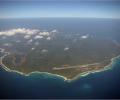
The project involves development of a military-civil, dual-use airport; international container trans-shipment terminal; a gas, diesel, and solar-based power plant, and a township.

'We can expect heightened belligerence from China.'

'She's not going to keel over.' 'This is the kind of difficult situation that she thrives in.'

'When armies start attacking with clubs and batons, then at some point this can take an escalatory spiral and spin out of control.'
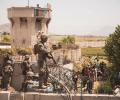
The US military efforts in Afghanistan were akin to filling a bucket that had gaping holes, asserts Colonel Anil A Athale (retd).

The US actions can be seen as a riposte to India's neutral position on the Ukraine crisis, its continuing import of Russian arms and oil thus undermining Western sanctions, argues Colonel Anil A Athale (retd).
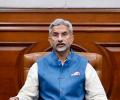
The Indian Army will not let China change the status quo along the Line of Actual Control (LAC) "unilaterally" and its current deployment along the frontier was not seen before, External Affairs Minister S Jaishankar said on Monday, rejecting Congress leader Rahul Gandhi's criticism of the government's handling of the border row.
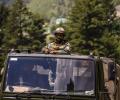
The remarks by the Chinese foreign ministry came a day after Secretary of State Mike Pompeo assured India that the US stands firmly with it to confront threats to its sovereignty.

At her daily news conference on Wednesday, White House Press Secretary Jen Psaki was asked how the world's largest and oldest democracies are working together to bring peace in the region amidst the war in Ukraine.

He said there were no signs of an "overt collusion" between China and Pakistan during the Ladakh standoff but India also caters to a long term strategy for not a two, but a two-and-half front war. With the half front, he was referring to the internal security.

The Musharraf episode in the recent history of the subcontinent has convinced many realists in India that the hope of establishing peace with Pakistan is like accepting a dinner invitation from cannibals and expecting to live to tell the tale, points out Colonel Anil A Athale (retd).

If Mr Modi is to be blamed for the post-Godhra riots, he should also be given credit for maintaining peace after the Akshardham and Ahmedabad terror attacks. The BBC will never tell you that, points out Colonel Anil A Athale (retd).

The disengagement of troops of the Indian Army and China's People's Liberation Army from the Line of Actual Control was reached after sustained negotiations at the military and diplomatic level, said the ministry of external affairs last week.

'It is only when Beijing sees a country with an infirm political will such as India that it acts up as the PLA has done in eastern Ladakh.'
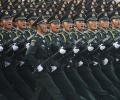
Protests at this time when efforts are underway to strengthen the PLA and keep morale high would be worrying for the military leadership, observes Jayadeva Ranade, the retired senior RA&W officer and distinguished China expert.
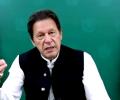
Pakistan Prime Minister Imran Khan on Friday launched the country's first-ever national security policy, which articulates a citizen-centric framework, placing economic security at its core unlike the previous one-dimensional security policy where the focus was on the military.
 © 2026 Rediff.com - Advertise with us - Disclaimer - Privacy Policy - Sitemap - Feedback - About us - Terms of use - Grievances